
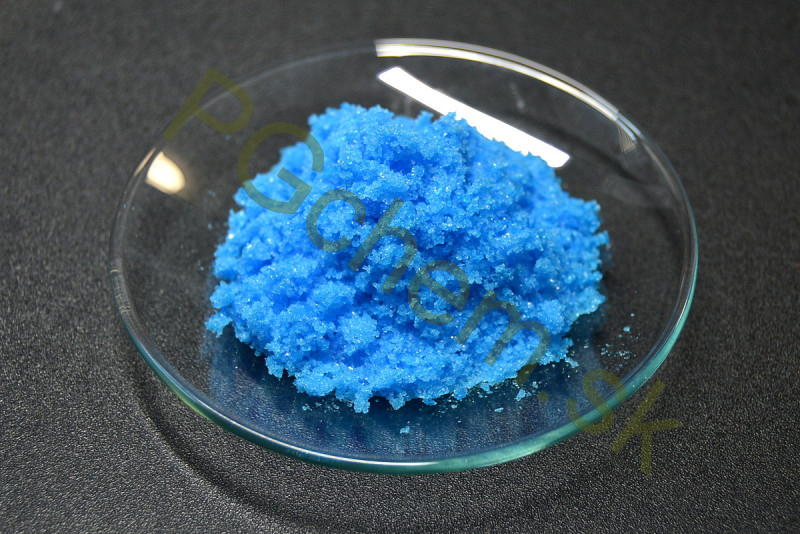
Copper sulphate, blue vitriol - ( 1 kg )
| Availability: | In stock |
 |
| Quantity: | x 1 ks | |
| Price with VAT: | 6,59 € ( 5,49 € without VAT ) | |
Name
Information
Copper sulphate (CuSO4), known under the trivial name of blue vitriol, previously as blue vitriol, is the most common compound of copper. The anhydrous is a white powder that blue water intake. Therefore, used to demonstrate the water in organic liquids or as desiccants.The aqueous solution crystallizes as a pentahydrate (blue vitriol), CuSO4 · 5H2O, in deep blue, transparent triclinic crystals, which air on the surface winds. Blue vitriol is technically the most important salt of copper.
Exploitation
The material for the production of mineral colorsImpregnation of wood against rot
Canning stuffed
Seed dressing
Bordoská Jicha (a mixture of copper sulfate solution and lime milk) - a means of pest control for vegetable crops
Control of algae in swimming pools
Removing moss from roofs
Part poměďovacích spa
Dyeing leather
Astringent, and keyer etching agent in medicine
Interestingly: How to create crystal copper sulfate - instructions
1st Make a saturated solution of copper sulfate:
Heat the water to about 50 degrees Celsius and dissolve copper sulphate in it so long as it stops dissolving (temperature maintained at 50 degrees Celsius).
2nd When will cease to dissolve, pour the solution into another container and allow to cool spontaneously (the longer the solution to cool, the better). On cooling crystals begin to form. Once the solution has cooled to room temperature, leave the room for several days. The solution will evaporate the water and the crystals will continue to grow.
3rd If the resulting crystals are too small, repeat the procedure, but the starting temperature at which you Skalica dissolve, reduce to 30, a maximum of 40 degrees Celsius. Maybe even less - then the longer it will take crystal growth by evaporation. The crystal growth is necessary and supersaturated solution time. (A supersaturated solution occurs in the first and second part of the cooling by evaporation. By cooled and there is saturated with the solution and begin to fall out crystals, then the solution further satiate evaporation.)
The largest crystals grow in the evaporation stage. The longer the evaporation stage, the better for the size of the crystal.
If you choose the initial saturation temperature is high, there is a rapid cooling overloading and resulting large number of small crystals. If this happens, it is necessary to reduce the initial temperature (see above).
Our tip: interesting shapes you can achieve if you put in a solution stone or other small object on which you want to be picked crystals, or by immersion in a string tied to a pencil that you put over the top edge of the glass.
Specifications
CAS: 7758-99-8
EC: 231-847-6
Limit ADR (kg, l): 1000
UN: UN3077
Expiration (months): 24
Melting point / freezing point (° C): above 110 ° C. loses water of crystallization, above 650 DEG C. dec.
FLASH POINT: not flammable
Relative density: 2,280
Solubility in water: 1000 g / l
Cop: min. 23.5%
Fe: 0.2% maxCountry of origin
Romania
Toxicological data
Copper sulphate is a toxic substance, and after swallowing there is strong vomiting with blood. The victim can die within 7 hours. Swallowing larger amounts even earlier. As an antidote, give the affected milk and induce vomiting immediately.
Storage
Keep tightly closed in the original container.
UPOZORNENIE:


Signal word: Warning
H302 - Harmful if swallowed.
H319 - Causes serious eye irritation.
H315 - Causes skin irritation.
H410 - Very toxic to aquatic life with long-lasting effects.
P273 - Avoid release to the environment.
P280 - Wear protective gloves/protective clothing/eye protection/face protection.
P301+P312 - IF SWALLOWED: Call a POISON CENTER/doctor/…/if you feel unwell.
P305+P351+P338 - IF IN EYES: Rinse cautiously with water for several minutes. Remove contact lenses if present and easy to do – continue rinsing.
P337+P313 - If eye irritation persists get medical advice/attention.
P302+P352 - IF ON SKIN: Wash with plenty of water/…